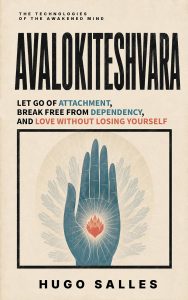
About AVALOKITESHVARA: Let Go of Attachment, Break Free From Dependency, and Love Without Losing Yourself by Hugo Salles
“Suffering is not born from love. It is born from trying to hold the wind in a closed fist.” A Tibetan practice for loving without losing yourself, explained mechanism by mechanism.
Jealousy at three in the morning. The anxiety of an unanswered message. The fear of being left behind. The ending that continues to live inside you long after the relationship is over. We call it love, intensity, or devotion, until a more honest look gives that urgency another name: attachment.
AVALOKITESHVARA examines one of the most universal wounds there is. For more than a thousand years, Tibetan practitioners developed a mental technology for this exact pattern. What the tradition calls Avalokiteshvara is the name given to the capacity to listen to suffering without closing down. The figure with a thousand arms is not a deity to worship: it is a diagram of attention. Om Mani Padme Hum is a vocal attention technique kept alive by centuries of practitioners, not a prayer to be repeated on faith.
Through tonglen, the meaning of Om Mani Padme Hum as a focus tool, the three poisons, and reflections on dependence, abandonment, and separation, the book explores how emotional pain can become conscious care rather than a wound that keeps reopening.
Written for readers of any background, AVALOKITESHVARA is for those who want to love with greater freedom, honesty, and compassion, without disappearing inside another person. No previous knowledge of Buddhism is required. It is the second book in The Technologies of the Awakened Mind series.
You do not need to love less. You only need to open the hand without closing the heart.
Buy the book, and follow the author on social media:
Learn more about the writer. Visit the Author’s Website.
Author Bio:
Hugo Salles is a Brazilian writer, lawyer, and executive. For more than fifteen years, he has led teams and projects, experience that has brought his study of Mahayana and Tibetan Buddhism into direct contact with the challenges of everyday life, including fear, conflict, guilt, attachment, and difficult decisions. As part of his independent study, he has translated selected Buddhist sutras into Portuguese, working with canonical texts, established translations, and traditional commentaries. In his series “The Technologies of the Awakened Mind,” he explores how the teachings, symbols, and practices associated with figures such as Tara, Manjushri, Avalokiteshvara, and Vajrasattva can help cultivate courage, clarity, compassion, purification, and discernment. His books follow a simple principle: teachings should not be accepted solely on the authority of the person presenting them. They should be practiced, observed, and tested through one’s own experience.