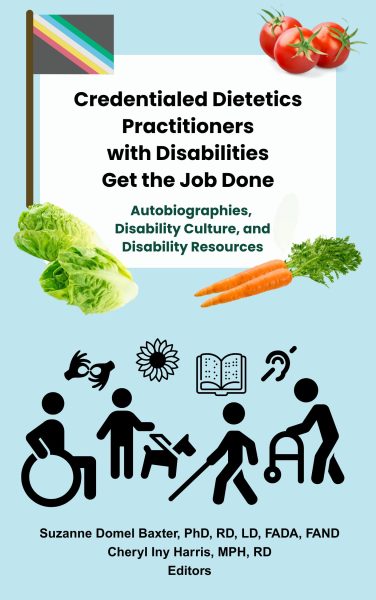
Credentialed Dietetics Practitioners with Disabilities Get the Job Done by coeditors Suzanne Domel Baxter, PhD, RD, LD, FADA, FAND and Cheyl Iny Harris, MS, RDN, LDN
“An involving, multivoiced look into the lives of disabled diet specialists.” – Kirkus Reviews
“Enlightening resource advocating for people with disabilities in the dietitian field.” – BookLife Reviews
“…insightful healthcare guide to broadening professional understandings of what competence looks like.” – Foreword Reviews
“…compelling call to build a profession where accessibility is the norm.” – The Prairies Book Review
“…inspiring roadmap and proof that dietetics is a viable profession for individuals with disabilities.” – BlueInk Review
“…practical and thoughtful volume that speaks to educators, students, employers, and colleagues…” – BookView Review
Recommended by three past presidents of the Academy of Nutrition and Dietetics, several disability leaders, and numerous dietetics practitioners.
What does it take to build a career as a credentialed dietetics practitioner in a world that wasn’t designed for disabilities?
Credentialed Dietetics Practitioners with Disabilities Get the Job Done is a pioneering collection of true stories from 15 credentialed dietetics practitioners with disabilities. Their stories challenge stereotypes and show that disability can be a source of insight, adaptation, and professional strength.
Dietetics practitioners are food and nutrition experts who help people eat better, reduce disease risk, manage health conditions, and thrive. They work in healthcare, education, research, food service, government programs, private practice, and more. Yet despite serving a diverse population, the profession remains mainly female, white, and nondisabled. Approximately 2% of credentialed dietetics practitioners have a disability, compared with 29% of U.S. adults.
The contributors, who represent a wide range of disabilities, share their journeys through higher education, supervised practice, national credentialing examinations, employment, accommodations, disability disclosure, and disability culture related to food.
Their stories offer practical guidance to overcome barriers and show how disabilities can deepen empathy, strengthen patient care, and enrich the profession of dietetics.
Eight educational chapters cover topics such as:
– The dietetics profession and pathways into it
– The Academy of Nutrition and Dietetics
– The Disabilities in Nutrition and Dietetics Member Interest Group
– Disability resources, statistics, vocational rehabilitation agencies, and Centers for Independent Living
An essential resource for individuals with disabilities exploring healthcare careers; dietetics students and educators; career counselors and disability professionals; employers; healthcare practitioners; and families.
This book fills a long-overlooked gap in dietetics literature. It offers readers with and without disabilities new perspectives.
Ideal for academic, healthcare, and public libraries. Supports coursework, mentoring, diversity initiatives, and professional development.
All royalties support initiatives that advance disability inclusion in the dietetics workforce.
Hardcover, paperback, eBook, and audiobook.
Goodreads Giveaway through September 30, 2026
Buy the book, and follow the author on social media:
Learn more about the writer. Visit the Author’s Website.
Author Bio:
Suzi was born and raised in Texas. She has an older sister and a younger brother. She is a registered dietitian. She lives in South Carolina with her husband and two Siberian cats.
She completed a BS degree and Dietetics Coordinated Program at Texas Christian University, MS and PhD in nutrition at Texas Woman’s University, and post-doctoral fellowship in nutrition research at the Medical College of Georgia.
She has worked as a registered dietitian in a residential school for children with disabilities; in a hospital clinic for adults; in school foodservice; for the Women, Infants, and Children Program; and in nutrition research as a faculty member.
She acquired a mobility disability in 2010 which impacts her feet and hands. She had to stop driving a car. She uses a power scooter. She resigned her faculty position in late 2016. She is now a disability advocate and passionate about increasing awareness of careers in nutrition and dietetics. She co-founded the Disabilities in Nutrition and Dietetics Member Interest Group within the Academy of Nutrition and Dietetics. She serves on the Board of Directors for Able South Carolina. She volunteers for Disability Rights South Carolina on the Community Outreach Advisory Council and the Voting Coalition.