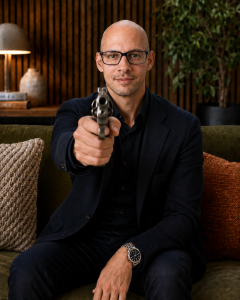
Interview With Author Daniel Wille
Tell us about yourself and how many books you have written.
A year ago, I was working on The Da Vinci Hunt, a novel centered on my beloved gentleman thief, Jake Rook—a story originally developed as a screenplay. That script garnered interest from major industry players, including CNC France, Buffalo 8, the production team behind the international hit The Intouchables (1+1), and acclaimed actors like Giancarlo Giannini.
While developing that project, an idea for a standalone short story began to take shape. I shifted gears briefly to explore it, but what was meant to be a quick piece rapidly evolved into an intricate labyrinth of character trials and narrative twists. That organic expansion ultimately gave birth to Jake Rook: The Degas Trap, which is now making its way into the world…
What is the name of your latest book and what inspired it?
My latest book is Jake Rook: The Degas Trap. It serves as the ultimate introduction to an elusive, charismatic mastermind thief—setting the stage for the upcoming, high-stakes caper centered on the world’s most expensive artwork: Leonardo da Vinci’s Salvator Mundi. That storyline ignites a relentless international chase involving mob syndicates, corrupt officials, aristocrats, and, of course, Rook himself facing off against his unyielding nemesis, Inspector Grant.
My inspiration stems from classic heist and mystery traditions—from literary icons like Maurice Leblanc’s gentleman thief Arsène Lupin and Agatha Christie’s brilliant Hercule Poirot, to cinematic favorites like Ocean’s Eleven, Ocean’s Twelve, Ca$h, Crime Spree, Mission: Impossible, and National Treasure. Lately, I noticed that these clever, witty, character-driven adventures have become a rarity. I deeply missed that golden blend of sharp intellect, humor, and daring stunts—so one winter night, I simply decided to write the story I wanted to read.
What matters to me most is the aftertaste of a story. Too many modern thrillers leave readers with a grim, bitter feeling, even when the good guys win. I approach storytelling like a sommelier crafting fine wine: it should have rich layers, depth, and a finish that allows you to savor the experience long after the final page.
My favorite part of the craft is painting characters into absolute, seemingly inescapable corners and engineering ingenious ways out. By weaving dual plotlines with charismatic, memorable personalities and suddenly revealing the hidden bridge between them, you instantly have the reader hooked for the ride.
Do you have any unusual writing habits?
Music is an essential part of my process—specifically Jazz and Acid Jazz, which have scientifically backed benefits for creative cognition. Studies show that this type of music promotes neuroplasticity, quiets self-monitoring, and regulates neural oscillations linked to focus and relaxation, helping me enter a flow state much faster.
Alongside the music, I rely heavily on an extensive blueprint before typing out the first scene. I map everything out in meticulous detail: target page counts, key punchlines, action choreography, jokes, and emotional beats.
When I need an extra spark or want to lock into the right creative rhythm, I often rewatch favorite scenes from classic capers or read a few standout pages from beloved novels. It instantly sets the pace and sharpens my focus
What authors, or books have influenced you?
My major literary influences include Agatha Christie, W. Somerset Maugham, Dan Brown, and Rafael Sabatini.
While modern storytelling often relies on cutting-edge technology and high-tech gadgets, I lean toward classic narrative traditions. Agatha Christie’s formula remains unbeatable: a tight circle of suspects, masterfully planted red herrings, and pure psychological deduction. Decades later, her mastery still sparks the ‘little grey cells’ of writers and filmmakers alike.
As for Rafael Sabatini, he is an absolute hero of mine. His life is the very definition of grit, resilience, and unwavering dedication to the craft. He didn’t achieve true widespread acclaim until nearly thirty years of relentless writing. Whenever the creative journey feels daunting, recalling his persistence reminds me to stay focused and never back down.
What are you working on now?
Right now, my primary focus is expanding the reach of Jake Rook: The Degas Trap. While it is currently available in English, I am actively working on translations into French, German, Italian, Russian, and Serbian to bring the story to a broader international audience.
Beyond literary distribution, I am exploring cross-media collaborations with fashion designers, board game creators, and film production partners. The visual and kinetic nature of the story makes it a natural fit for the screen, where it could truly deliver for crime and heist enthusiasts.
In parallel, I am creating an original art collection inspired by the most striking, pivotal moments of the narrative. The series will be showcased across curated online platforms as well as European art salons and galleries.
What is your best method or website when it comes to promoting your books?
Since I am relatively early in this publishing journey, I am actively experimenting and finding what works best. I believe every book is unique—there is no universal blueprint for promotion. It requires trial, observation, and tailored testing to discover which channels truly resonate with your specific target audience
Do you have any advice for new authors?
My advice comes from a very real, humbling lesson learned early on. When writing my first screenplay, The Family Business, I worked without an outline. I simply followed my imagination, thinking: ‘Let’s see where the journey takes me.’ While being both writer and surprised reader felt exhilarating, I ended up with a gargantuan 500-page script—enough material for four or five feature films! My script consultant and agents were stunned. It took me nearly a year of painful trimming to cut fourteen characters and fit the industry-standard 120 pages.
My takeaway is simple: always construct a detailed blueprint first. Map out at least 80% of your key turning points—the inciting incident, the midpoint shifts, the ‘all is lost’ moment, the cliffhangers, and the climax.
I call this ‘The Backward Architect’—an approach popularized by masters like Agatha Christie. Start with the culmination, know the ultimate reveal, and build backward from there. When you know where the tracks end, you can lay down a tight, intentional ride without getting derailed.
Bonus Advice: Overcoming the Blank Page & Gathering Daily Material
One essential technique I rely on to never face a blank page or an empty mind is what I call the ’10-Minute Observation Rule.’ >
Wherever you are—on public transport, in a café, shopping, or surrounded by friends—the world around you is a blank canvas. By observing a stranger’s behavior, subtle gestures, or an intriguing outfit, you can transform a prosaic, everyday situation into the foundation of a crime puzzle laced with secrets and intrigue. I practice this while walking or commuting across the city, challenging myself to construct the skeleton of a mini-mystery within ten minutes. Even an eye-catching photo in a magazine can spark the genesis of an entirely new crime scene. Practicing this daily ensures you always have fresh material stocked for future projects.
My second habit is critical reflection after reading or viewing. Whenever I finish a compelling novel, pilot episode, or film, I immediately take notes: what resonated, how specific beats made me feel, and—most importantly—what I would have improved or handled differently. Deconstructing other narratives reinforces creative problem-solving and lets you stock an ‘invisible rack’ of refined ideas ready for your next literary journey.
What is the best advice you have ever heard?
Two complementary pieces of advice have shaped my process:
Write longhand with a pen — an approach famously championed by Neil Gaiman. Beyond the tactile pleasure of ink on paper, handwriting offers distinct cognitive advantages: it slows down impulsive phrasing, boosts neural connectivity, and engages deeper memory retention, giving words room to breathe before they hit a screen.
‘Write drunk, edit sober’ — a classic maxim often attributed to Ernest Hemingway (which I take metaphorically!). For me, it represents the vital separation between creation and curation. During the initial drafting phase, I pour all raw thoughts, unfiltered scenes, and wild plot ideas into one pot without second-guessing. The next day—with a clear, analytical eye—I begin the sorting, structuring, and refinement process.
What are you reading now?
Agatha Christie’s Elephants Can Remember. I picked it up after revisiting the screen adaptation starring the incomparable David Suchet.
In my opinion, it is one of Christie’s most ingeniously twisted and compelling works. The layered psychological puzzle and its eerie, lingering atmosphere left me brimming with fresh narrative ideas and a genuine sense of suspense.
What’s next for you as a writer?
My immediate focus is finishing my upcoming full-length novel adapted from my earlier screenplay. Readers can expect high-octane action, intricate puzzle-solving, and a cast of ruthless yet thoroughly charming characters.
I am currently about 40% through the draft and aiming for a release in bookstores ahead of next summer.
If you were going to be stranded on a desert island and allowed to take 3 or 4 books with you what books would you bring?
A good question. My island companions would be the definitive masters of classical intrigue and intellect: Agatha Christie for her unmatched puzzle engineering, Maurice Leblanc for the charm and daring audacity of Arsène Lupin, and Arthur Conan Doyle for the timeless deductive stepstones of Sherlock Holmes.
Alongside these mystery giants, I would include a cornerstone of classical time-travel literature. Transporting your mind across eras through classical narrative craft is the ultimate way to stay inspired.
Author Websites and Profiles
Author Interview Series
To discover a new author, check out our Featured Authors page. We have some of the best authors around. They are just waiting for you to discover them. If you enjoyed this writer’s interview feel free to share it using the buttons below. Sharing is caring!
If you are an author and want to be interviewed just fill out out Author Interview page. After submitting we will send it out in our newsletters and social media channels that are filled with readers looking to discover new books to read.
If you are looking for a new book to read check out our Featured Books Page.