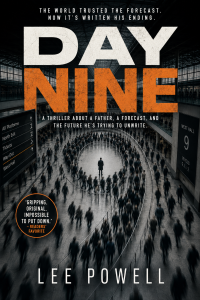
About DAY NINE
Daniel Reeve taught the world to trust the forecast. He proved it never missed. He wrote the rule everyone lives by now: you do not fight it, because fighting it is how it comes true.
Then it read him.
Nine days out, to the hour, it tells him he will cause the death of someone he loves. By the next morning he knows whose.
June. His daughter, who stopped speaking to him years ago, and who lives by refusing the very system he built.
She does not want his protection. He gives it anyway. He stays away from her, breaks every plan, refuses at every turn to become the man in the forecast. And every reasonable, loving thing he does carries him one step closer to the room, and the hour, and the act.
The system is not predicting him. It is arranging him.
By the things he wants. By the good reasons. By the parts of himself he trusts most.
Her mother believes the forecast the way the whole world does, because Daniel taught it to, and she will do anything to keep him away from their daughter before the ninth day comes. Every move she makes to save June becomes another part of the route.
The only way out is a choice so far against his own nature that the man who makes it will not be the man who built any of this.
The clock does not stop. The forecast does not blink.
Nine days. He has read the ending. He has not agreed to it.
Buy the book, and follow the author on social media:
Learn more about the writer. Visit the Author’s Website.
Author Bio:
Lee Powell writes about the systems people find themselves inside before they can see them. He is the author of the field guides Stop Feeding the System and ManOS, and the novels LOADED: An Archive, The God Protocol and DAY NINE. His fourth novel, The Witness Layer, is in progress.
Before returning to books, he built document software used by writers worldwide, including Scrivener and Scapple for Windows, built IBM's first online retail platform, and delivered systems inside banks, exchanges and government agencies. He holds an MSc in Software Engineering from the University of Oxford.
Alongside the writing, Powell paints. The canvases work the same seam as the books: a structure built, buried under paint, then cut back until it shows through. Originals and a small number of prints sit in private collections in Australia, the United Kingdom, and the United States, and are available by inquiry.