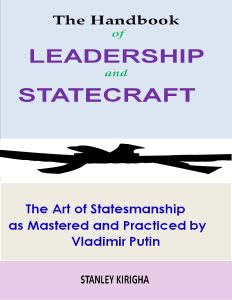
About The Handbook of Leadership and Statecraft: The Art of Statesmanship as Mastered and Practiced by Vladimir Putin authored by Stanley Kirigha
Like him or hate him, Vladimir Putin is one of the most remarkable leaders of his time. For close to three decades, he has survived the rough and tumble of politics in Russia. Born to working-class parents, he rose to the presidency against all odds, consolidating a large and diverse country after the collapse of the communist system, reversing its slide into hopelessness, chaos, and poverty. He nudged Russia into a strong, thriving market economy, surprising foes and friends alike.
He expertly built up his political stock, becoming the undisputed, unbeatable politico supremo locally and a colossus on the world stage.
“The Handbook of Leadership and Statecraft: The Art of Statesmanship as Mastered and Practiced by Vladimir Putin,” unveils Putin’s toolbox of leadership and management. It encapsulates topics such as leadership traits, building political clout, leveraging resources and systems, fine-tuning the machinery of governance, and playing the political chessboard.
The book also includes some illuminating tidbits of Putin’s thoughts on a broad range of contemporary philosophical questions such as ‘True Friendship, ‘The Dream of a Common Europe,’ ‘The Dangers of Exclusionism,’ ‘Cancel Culture, ‘Source of Personal Happiness,’ ‘Technology and the Future,’ ‘Revolution and Evolution,’ Stardom Disease,’ ‘Comparing Napoleon, Erhard, Roosevelt,’ ‘What if Russia had Lost in World War II?,’ ‘Prenuptial Agreements,’ ‘The Demographic Problem,’ ‘Can Russia join NATO,’ ‘Legal Nihilism,’ ‘Struggle for People’s Minds,’ ‘Putin, the Lonely Democrat?’ ‘Terrorists’ Main Weapon,’ and many others.
There is much in the book that practitioners of various disciplines, and those seeking success in various fields of human endeavor, can learn and apply profitably.
Buy the book, and follow the author on social media:
Author Bio:
Stanley Kirigha is an economist enthused by the broad topic of economic development. He is intrigued by the fact that different societies and nations, some of which appear to have much in common in terms of the underlying social-cultural topographies nevertheless register individually distinctive development trajectories. He is keen to explore and understand the forces and factors that shape or explain particularities in societal development. In this regard, he assesses the contribution made by social, political, and cultural systems and the role played by leadership. He shares the results of his analyses in his writings.