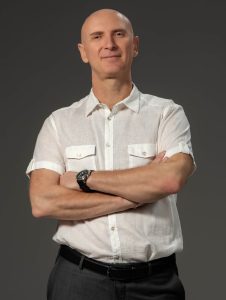
Interview With Author Emiliano Poloni
Tell us about yourself and how many books you have written.
My name is Emiliano Poloni, and I was born in a small town in northern Italy in the 1970s. At fifteen, I left home to attend a technical aeronautical boarding school. At nineteen, I joined the Italian Air Force, where I served as a military transport pilot for twelve years, flying the C-130 on missions around the world — from Afghanistan to Canada, from Australia to the Middle East.
After leaving the military, I joined Air Dolomiti, an Italian airline owned by the Lufthansa Group. Ten years later, I became part of the Qatar Airways family. I am currently an Airbus A380 pilot, living in Qatar with my wife Daniela, our two teenage children, Maria and Matteo — and our five cats.
I have always had a passion for writing, born from an early love of reading during my school years. Nearly twenty years ago, I wrote two novels — one science fiction and one fantasy, both thrillers. At the time, however, I had little understanding of the professional publishing world. Every revision was done by me and my first readers: my parents and siblings.
In recent years, I decided to approach writing with a professional mindset. Every manuscript now goes through editing, proofreading, formatting, publication, translation, and marketing. To give structure and identity to this creative journey, I founded EPStories — a narrative universe and publishing brand under which I release my work.
Dream Loop – The Awakening marks the first official chapter of this new path. More stories are already in development.
What is the name of your latest book and what inspired it?
My latest book is Dream Loop – The Awakening.
The idea began to take shape during the COVID years, when I experienced long periods of confinement — weeks at a time — either at home in Doha, Qatar, or in hotel rooms around the world while flying. As a pilot, I saw firsthand how different countries managed the crisis. In some of the most advanced nations, crews were escorted directly from the aircraft by police and taken to designated hotels, where we were confined to our rooms for days. Meals were left outside the door. Contact was reduced to almost nothing.
Experiences like these inevitably plant seeds in a writer’s mind. From that sense of isolation and invisible containment emerged the concept of the Dream Loop — a prison where no one realizes they are prisoners.
Of course, Dream Loop is a work of science fiction and is not about COVID or public health policies. As I often say, ideas are like seeds. At first, they are only an emotion — a faint, almost intangible spark. The author decides how to nurture them, and the story grows in its own direction.
Do you have any unusual writing habits?
Not really. I don’t follow a strict routine or a rigid schedule. Contrary to what people might expect, I rarely write between flights. Some of my flights last fourteen or fifteen hours, often overnight. The constant time zone shifts tend to scramble my mind. In those moments, not only do the sentences refuse to flow onto the page — they don’t even form properly in my head. Whenever I try to force it, the result is never good.
That’s why I write at home — in Qatar — where I can find mental clarity and quiet. Occasionally, I write in Italy as well, but most of the time there I find myself driving from one relative’s house to another before heading back to Doha.
What authors, or books have influenced you?
I grew up in the 1980s, so alongside the classics I discovered in my aunt’s house — from Quo Vadis to White Fang — but my first true encounter with modern fiction was The Long Walk by Stephen King. The rawness of the story, combined with the simplicity of its characters placed inside such an absurd and merciless world, felt strangely natural. In a way, I was there with them, walking along the roadside, knowing no one would ever shoot me in the head.
Another powerful influence was Salem’s Lot, also by Stephen King. Around the same time, I discovered Michael Crichton through The Andromeda Strain, which opened the door to a broader fascination with science fiction and speculative storytelling.
From there, the path led naturally toward epic fantasy, eventually reaching George R. R. Martin and A Game of Thrones.
Each of these authors shaped a different layer of my imagination: psychological tension, scientific realism, and expansive world-building.
What are you working on now?
I’m currently working on a new sci-fi thriller set on Callisto, Jupiter’s dark moon.
Dr. Clara Dorne — known in the medical community as “the goddess of the mind” — has just brought her husband, a former soldier, to Callisto in search of a cure for his memory loss, caused by an accident on Mars. On Callisto stands Hypnos Base, a research facility renowned for breakthroughs that originated from Clara’s own work.
But Clara soon discovers that her husband’s memory loss is not the result of trauma — it is the product of deliberate manipulation. And she is the one who engineered it.
The problem is that she erased her own memory as well.
What follows is her obsessive descent into uncovering what she was trying to hide from herself — a truth that will drag the entire scientific base toward collapse.
At the same time, I am working on a mini-novel connected to the universe of Dream Loop – The Awakening. It tells the story of a group of legionaries before the launch of the Key York, focusing on their final mission on Earth. The story expands on key characters and answers lingering questions from the main novel.
What is your best method or website when it comes to promoting your books?
The list is long — and I’m still in the process of understanding which methods work best for me. That said, everything starts with a solid foundation: a core group of friends, acquaintances, and early readers who genuinely support my work. At every launch, they are the first to show up. That early momentum matters.
I’m also building an ARC team — a group of advance readers who provide feedback and help generate early reviews. Alongside that, I run Amazon Ads and Facebook campaigns to expand visibility and test different audiences.
Communities like this one are also valuable. Connecting with other authors and readers creates conversations that go beyond simple promotion.
Finally, EPStories has its own dedicated website, where I publish articles, in-depth insights, my books, and previews of upcoming projects. I believe long-term promotion is about building a narrative ecosystem, not just launching individual titles.
Do you have any advice for new authors?
Be the first and most ruthless critics of your own work. I’ll spare you what Hemingway famously said about first drafts — he was particularly explicit — but the point remains the same: your initial version is rarely your best.
Many great writers have obsessed over the smallest details. Alessandro Manzoni, for example, was said to wake up in the middle of the night to revise a single paragraph that troubled him, unable to decide whether a comma belonged there or not.
If something doesn’t feel right, it isn’t. Readers can sense it immediately. Your job is to guide them along the road, to engage and accompany them — not to drag them forward by force.
And above all, don’t be afraid to “kill your heroes” if they no longer serve the story. Sometimes they are only reflections of our own ego. The story must always come first.
What is the best advice you have ever heard?
When I was seven or eight years old, my father read something I had written for a school assignment. He looked at it and said, very simply: “It doesn’t make sense. I don’t understand any of it. How can you write something like this?”
It wasn’t poetic advice. It wasn’t motivational. But it was honest.
Over time, I realized how valuable that moment was. Writing is not about sounding intelligent — it’s about being clear. If the reader doesn’t understand you, the problem is never the reader.
What are you reading now?
At the moment, I’m rereading Firstborn by Arthur C. Clarke and Stephen Baxter. I’m drawn to the way they describe space environments — vast, indifferent, and almost majestic in their scale. Their ability to blend scientific rigor with a sense of cosmic awe is something I deeply admire.
Even when the narrative becomes expansive and speculative, the environments feel grounded and tangible. I’ve always been fascinated by that balance between realism and wonder.
What’s next for you as a writer?
To keep writing — and to write better stories each time.
I want to improve in every aspect: structure, style, emotional depth, and narrative tension. For me, writing is not just about finishing a book; it’s about refining the craft with every project. Each story is an opportunity to grow — technically, creatively, and personally.
The goal is simple: stronger structure, sharper prose, deeper engagement. Always forward.
If you were going to be stranded on a desert island and allowed to take 3 or 4 books with you what books would you bring?
I would bring The Long Walk and The Shining by Stephen King — two very different forms of psychological tension that have stayed with me for years.
I would also take 2001: A Space Odyssey by Arthur C. Clarke. The sense of cosmic scale and existential mystery in that book never fades.
And perhaps, for purely practical reasons, a copy of How to Survive on a Desert Island.
Just in case imagination alone isn’t enough.
Author Websites and Profiles
Emiliano Poloni Amazon Profile
Emiliano Poloni’s Social Media Links
Author Interview Series
To discover a new author, check out our Featured Authors page. We have some of the best authors around. They are just waiting for you to discover them. If you enjoyed this writer’s interview feel free to share it using the buttons below. Sharing is caring!
If you are an author and want to be interviewed just fill out out Author Interview page. After submitting we will send it out in our newsletters and social media channels that are filled with readers looking to discover new books to read.
If you are looking for a new book to read check out our Featured Books Page.