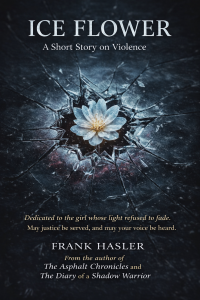
About Ice Flower – A Short Story on Violence: A Literary Exploration of Silence, Trauma, and Radical Loyalty
A haunting literary journey into the architecture of trauma.
Ice Flower is a visceral and uncompromising literary work about trauma, silence, and the devastating consequences of being unheard. Told through an intensely embodied voice, this short story follows a deaf girl whose only language—sign, touch, and physical memory—is violently disrupted by loss, institutional coldness, and enforced “safety.”
After the disappearance of her mother, silence becomes not absence, but an oppressive, physical force. What begins as grief transforms into a radical loyalty to pain—the only remaining proof of belonging.
Moving between past and present, Ice Flower exposes trauma as a cyclical struggle rather than a path toward healing. Hospitals, institutions, and well-meaning authority figures appear as sterile environments that neutralize pain instead of witnessing it. Against this emotional frost, the story insists that wounds demand recognition—not management.
Written in lyrical prose, Ice Flower confronts readers with uncomfortable questions:
What happens when logic replaces listening?
When protection becomes abandonment?
When survival itself is labeled irrational?
This is not a story of redemption. It is a story of witness.
Ice Flower will resonate with readers of literary fiction, trauma narratives, and philosophical prose—especially those interested in themes of disability, grief, embodiment, and the fragile boundary between care and control.
Buy the book, and follow the author on social media:
Author Bio:
Frank Hasler was born in Berlin-Tempelhof and raised in Hannover, Germany. His writing is deeply rooted in the gritty, realistic perspective of a man who has spent over a decade working the “front lines” of human experience.
As a psychological counselor and systemic coach, Hasler navigated the fracture points of society—working in youth welfare, crisis intervention, and with refugees and trauma survivors. These “shadow zones” of reality serve as the foundation for his literary voice.
In his work, Hasler doesn’t go looking for heroes; he looks for the truth. He writes about what remains when the system fails, capturing the quiet, simmering defiance of those who keep moving forward against the odds.
With The Asphalt Chronicles (Die Asphalt-Chroniken), he opens the first chapter of his Noir universe: a collection of stories exploring guilt, control, and the grueling effort to remain human in the dark.