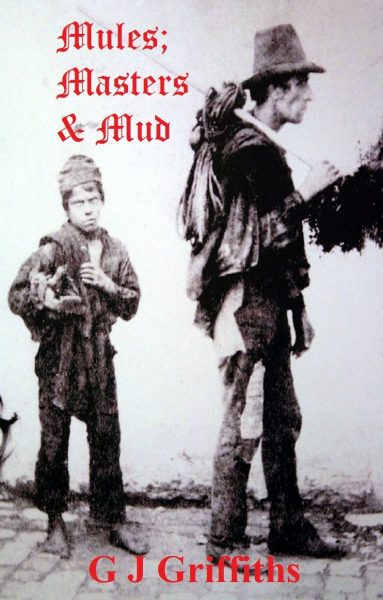
Mules; Masters & Mud by G.J. Griffiths
WARNING! This book may contain NUTS! (Non-Uniform Text Speech)
In other words speech in what some have called “Olde English Vernacular”. It is spoken by characters in the book from the North, the Midlands and the South of England. There is a glossary at the end of the book to help if you can rise to the challenge. It adds shades of colour to this 19th century story that you may not be expecting.
When Mrs Alexander wrote about “the rich man in his castle, the poor man at his gate” and declared that “God made them, high or lowly, and order’d their estate” in the ever popular hymn All Things Bright and Beautiful, she was probably reflecting one of the mores of the times. It would fit in well with prejudices and beliefs of the middle and upper classes that paternalism had indeed been intended by God, thus laws protecting the workers in their fields, mills and factories were not necessary. In the words of Browning so long as “God’s in his heaven, all’s right with the world!”
The continuing story of the Quarry Bank Runaways is about what happened to two cotton apprentices over three decades during the Industrial Revolution; first as qualified young men with hopes and later when they are full grown. By the start of the Victorian period the fates and their ambitions would have collided. Serious events and incidents, both personal and national, were about to impinge upon the lives of Thomas Priestley and Joseph Sefton, who had earlier run away from their apprentice master, Samuel Greg. What would cause a qualified mule spinner to give up his comparatively safe job and risk failure, ridicule or destitution? Ambitious and determined working class individuals like Tommy and Joe had to carefully step through a pathway involving love, loyalty and legal persecution and prejudice, from within the social hierarchy of the times.
Thomas Priestley and Joseph Sefton were skinny teenage boys, paupers, taken from their mothers as small children to live in the Apprentice House and work in the cotton mill in Quarry Bank, Cheshire. Injured and desperate they sneaked out from the mill in 1806 to walk 200 miles to London in order to see their mothers in Hackney workhouse. They did see them but it was after a week of adventures and, after an appearance in Middlesex Courthouse, where they were charged with breaking their indentures to cotton king – Samuel Greg.
Buy the book, and follow the author on social media:
Learn more about the writer. Visit the Author’s Website.
Author Bio:
G J Griffiths is a retired science teacher, with some early working experience of the photographic industry, who greatly enjoys being a grandad. Born in the UK he enjoys reading most genres of fiction such as sci-fi, crime/detective thrillers, historical and wildlife stories. Non-fiction reading mainly includes scientific or historical books. Walking in the English, Scottish or Welsh countryside with binoculars ready for bird-watching or other wildlife is a particular pleasure. Seeing badgers and otters in the wild recently was an exciting first. He now volunteers for Quarry Bank Mill museum from where he researched many of the facts found in his series called The Quarry Bank Tales.
His first novel was Fallen Hero. The So What! series of three books followed and these are all focussed around the fictitious Birch Green High School. They include: book 1, So What! Stories or Whatever!; book 2, So What’s Next! and book 3, So What Do I Do? Each book is quite different in its overall context, e.g. a collection of the teachers’ experiences; the creation of a school nature corner; and arson, fraud and murder investigated by detective Shantra, an ex-pupil from BGHS!
More recent works include poetry: Dizzyrambic Imaginings; two illustrated children’s sci-fi stories about ant-size aliens, Ants in Space and They’re Recycling Aliens; and a historical fiction series of 5 books based upon real characters from the Industrial Revolution period, The Quarry Bank Tales.
If you enjoy reading one of G J Griffiths’ books please share your enjoyment with other readers and post a review of it. This is very helpful for new writers and he would be pleased to hear from you on a Comments page at his website:
I worked as a volunteer tour guide at Quarry Bank Mill Museum for many months learning about the history of the mill, and discovering some of the real stories about children as young as 9 who worked there, often for no wages! Accumulating even more of the mill’s background historical tales as I progressed with my volunteer experience inspired me to write a series of 5 books in total. This sequel is called Mules; Masters & Mud and tells about the apprentices’ lives during the next three decades after their appearance in Middlesex Courthouse. It relates the events, trials and tribulations around the two as adults – right up until the death of Samuel Greg, the mill owner, in 1834.