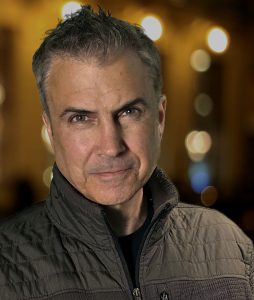
Interview With Author Sean Foy
Tell us about yourself and how many books you have written.
The Grotesque is my debut novel! Prior to the book, I’d spent nearly thirty years working in the film and video production industry, including making my own (mostly short) films and writing screenplays.
The Grotesque actually began as a screenplay. I found representation with it, and while producers often responded positively, the consistent feedback was that the story felt too contained. By expanding into a novel, I was able to widen that scope – adding darker psychological elements, bigger moments, and additional characters and tension – and the story really opened up. The novelization also allowed me to explore the characters’ inner lives in a much deeper, more meaningful way than had existed before.
My long-term hope is to bring it full circle – eventually adapting it back into a screenplay and, one day, seeing it made into a movie.
What is the name of your latest book and what inspired it?
My novel is The Grotesque, a psychological thriller that drifts into psychological horror. The original inspiration came from a simple idea: how different people might experience the exact same moment in radically different ways, based on their own pasts.
I imagined three people sitting in a café, watching a father toss a football with his young son in the park. One viewer sees a treasured father-son activity, a wonderful, bonding moment. Another sees a father unduly pressuring his son to be better. The third sees a frightened child, nearly in tears, trying to earn approval for something he clearly doesn’t enjoy. The scene itself never changes – only the lens through which it’s viewed.
That specific moment would be dull to write at length, but the concept intrigued me. What interested me most was how people with very similar backgrounds could diverge so dramatically in how they interpret the world, based on small but crucial differences in perspective. Trauma felt like a natural place to explore that idea, because it doesn’t just shape a single reaction – it rewrites everything that follows.
The title, The Grotesque, represents the novel’s core elements: the darkest experiences, those most hidden thoughts, and the worst that can be inflicted on a person and yet still be survived – whether that originates from the outside, or from one’s own sense of self. It’s also about the uphill battle that person will have to endure in order to reconcile those horrors, in order to free themselves to become the person they were meant to be.
Do you have any unusual writing habits?
I wouldn’t say I have any truly unusual writing habits. Over the years, I’ve tried to establish several routines, but what I discovered is that I write best when I can be near a window or sit outside whenever the weather allows.
When rewriting a scene and trying to nail down a specific mood or sense of urgency, I’ll sometimes listen to music (repeating the same song, ad infinitum), but I typically write best in silence. I’ll even put earbuds in without playing anything, just to shut the world out a bit.
The best habit for me though, is to simply write – whether I feel inspired or not. I’ll usually start by rereading what I wrote the day before or by revisiting a chapter that represents some of my strongest and most “on-point” writing before tackling the chapter ahead. My first pass will often be generally terrible, but the point is to get it down. Once I have something on the page, I’ll go back to edit, rearrange, and refine until it feels like I’ve found my voice again.
What authors, or books have influenced you?
Everything we read influences us to some degree. Some things are just more front-of-mind than others.
When it comes to The Grotesque, my writing style likely lands somewhere between Gillian Flynn and Chuck Palahniuk. While their writing styles are quite different from one another, both have a raw honesty in their writing that I love. Neither shies away from exploring the darker corners of the world or the human psyche.
From Flynn’s work, I was especially fascinated by the character of Camille in Sharp Objects and the outward manifestations of her inner torment. From Palahniuk, Fight Club left a lasting impression with its literal sense of duality and fractured identities.
Beyond books, I also found inspiration in Darren Aronofsky’s Black Swan. The hallucinatory nature of Nina’s obsession was definitely in the back of my mind while writing my novel.
What are you working on now?
At the moment, I’m focused on introducing The Grotesque to readers and expanding its current momentum. I’m also completing the visual effects on a short film I shot several years ago, a project I’m dying to finally bring across the finish line.
At the same time, I’m developing my next novel, a psychological horror centered on the haunting aspects of perception and grief. Like The Grotesque, it explores how personal connection shapes our perception of reality, but from a completely different emotional angle.
What is your best method or website when it comes to promoting your books?
Facebook has definitely been the most useful starting point, since it let me share the release with friends and family who became the book’s first readers. From there, Goodreads and Instagram have helped me reach people outside my personal circle and connect with influencers and specific genre readers.
I’m also branching into TikTok and Pinterest, all of which can be a challenge to keep up with, but I’m treating the entire process as a learning experience that I’m constantly refining. The trick is to focus my time on figuring out where the real connections are being made and to put more energy there.
Do you have any advice for new authors?
Don’t rush.
First and foremost, take the time to properly edit your work. More revision, beta readers, and, if financially viable, professional editing can make a huge difference. It also helps to plan a budget early, including costs for editing, marketing, and even author copies for giveaways and events.
When you’re finally ready to publish, do your research. There are excellent resources online that’ll walk you through the process – and understanding it ahead of time makes a huge difference. Make a checklist. ARC readers and a pre-order window can also build early excitement.
And finally – one of the hardest lessons for me – don’t be shy about talking about your book! If you don’t advocate for your own work, no one else will.
What is the best advice you have ever heard?
The best advice I ever heard regarding any creative work was: “Finish it.” Without that, there is nothing else. No one cares about a story that’s half-finished.
What are you reading now?
I always have a tall TBR pile, but I’m currently reading The Unseen, by Ania Ahlborn. I enjoyed her novel Brother and was immediately interested in reading more of her work. I’ve been focusing on horror-thrillers lately, as I prepare to write my next novel, though I also have a few off-genre books by friends waiting in the stack.
What’s next for you as a writer?
I’m currently developing my next novel, a psychological horror centered on perception and grief. Beyond that, I’m interested in continuing to explore stories that delve into imagination, family dynamics, and how perspective reshapes reality. I’m drawn to characters – sometimes dark and sometimes not – whose hopes and dreams are in direct conflict with the reality of the external world, and what happens when those two versions of truth collide.
If you were going to be stranded on a desert island and allowed to take 3 or 4 books with you what books would you bring?
I’d probably want a mix of entertainment and practicality. For enjoyment, I’d bring The Hitchhiker’s Guide to the Galaxy by Douglas Adams – I have all five books in one volume, which feels like a fair-enough loophole to still count as one book. I’ve reread it countless times, and its take on the absurdity of life might be especially useful if I were stranded alone on an island.
I’d also bring The Iliad and The Odyssey by Homer, since they’ve been sitting unread on my shelf forever, and I’d finally have no excuse.
As for the fourth book… probably a survival guide. Entertainment is a great and necessary part of life, but some practical know-how seems like a wise decision if I want to live a good, long life on a desert island.
Author Websites and Profiles
Sean Foy’s Social Media Links
Author Interview Series
To discover a new author, check out our Featured Authors page. We have some of the best authors around. They are just waiting for you to discover them. If you enjoyed this writer’s interview feel free to share it using the buttons below. Sharing is caring!
If you are an author and want to be interviewed just fill out out Author Interview page. After submitting we will send it out in our newsletters and social media channels that are filled with readers looking to discover new books to read.
If you are looking for a new book to read check out our Featured Books Page.